
- Home
- Stucco Mesh and Lath That Hold the Wall
Stucco Mesh and Lath That Hold the Wall
Reinforcement is buried inside the wall, so nobody sees it until cracks appear. Metal lath in hard coat and fiberglass mesh in EIFS have to be lapped, fastened and placed correctly, especially at the corners of windows and doors.
- Metal lath for hard coat
- Fiberglass mesh for EIFS
- Diagonal corner patches
- Crack-causing defects fixed

Request a consultation & estimate
Residential or commercial. We’ll get back to you to set up an evaluation.
We never share your information. Prefer to talk? Call (888) 592-1304.
What keeps stucco from pulling apart
Cement and polymer base coats are strong when squeezed but weak when stretched. Reinforcement is what lets the wall handle the stretching that comes from shrinkage, temperature swings and framing movement. In hard coat stucco that job belongs to metal lath: expanded diamond mesh or woven wire, fastened through the weather barrier into the studs. In EIFS it belongs to fiberglass mesh embedded in the base coat over the foam.
The details are where reinforcement succeeds or fails. Lath sheets must overlap at sides and ends and be wired or fastened at the laps, and the fasteners have to hit framing, not just sheathing. Lath also needs to be held slightly off the barrier so cement can wrap all the way around it. EIFS mesh must be continuous, overlapped at every seam and wrapped around corners.
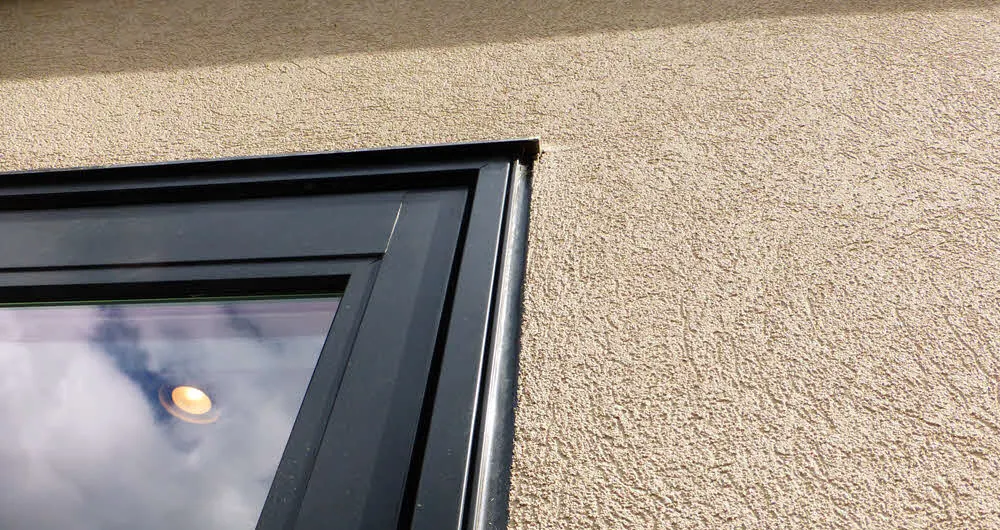
Openings concentrate stress. Without extra diagonal pieces at each window and door corner, cracks almost always start there. Read about the coats that hold the reinforcement on stucco base coat, and about crack repair on fixing stucco cracks.
Reinforcement mistakes that cause cracks
When we open a cracked wall, these are the defects we see most often.
No diagonal patches
Missing diagonal mesh or lath at window and door corners lets cracks run out from each corner at an angle.
Short or missing laps
Lath sheets or mesh rolls that only butt together leave a weak line where a straight crack forms.
Fasteners missing framing
Lath fastened only into sheathing can sag or pull loose, and the stucco cracks or bulges with it.
Lath flat on the barrier
When lath is not furred out, cement cannot wrap behind it and the coat is poorly locked to the wall.
Corners not wrapped
EIFS mesh that stops at an outside corner instead of wrapping it leaves the edge prone to cracking and impact damage.
Rusted lath
Where water has sat behind hard coat for years, lath corrodes and the stucco loses its grip.
Often paired with this work
Most wall problems involve more than one part of the envelope.

Stucco
Stucco is a family of wall systems, not a single product.
Learn more
Stucco Contractor
Plenty of crews can trowel a finish coat.
Learn moreHard Coat Stucco
Three-coat portland cement stucco is the original masonry finish: dense, durable and solid to the knock.
Learn more
Traditional Stucco Finish
The finish coat is the part of a stucco wall everyone sees.
Learn more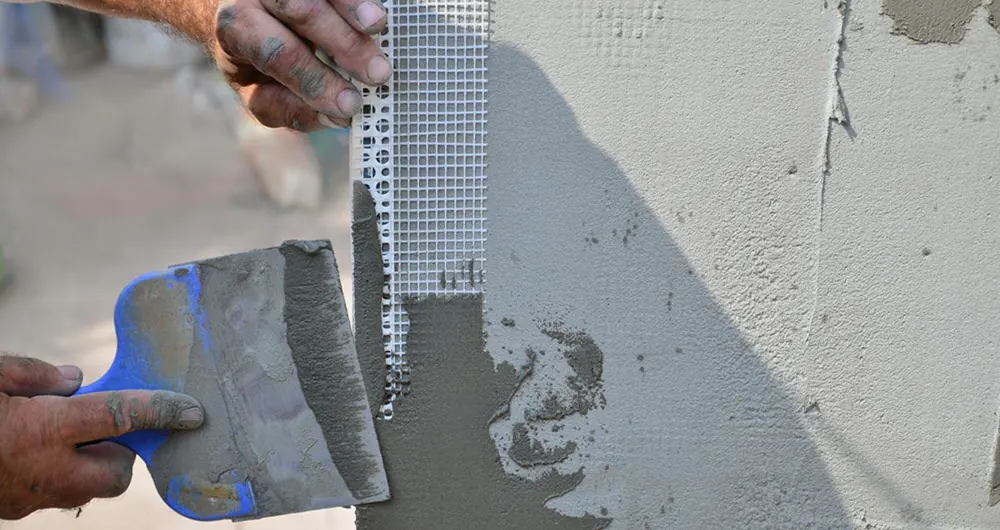
Stucco Cement
Most cracking in cement stucco is decided at the mixing board and in the first days after application.
Learn more
Stucco Base Coat
The base coat is the body of any stucco or EIFS wall.
Learn moreChoosing lath and reinforcing mesh
Different walls call for different reinforcement. Self-furring expanded metal lath is common on framed walls under hard coat. Woven wire suits some substrates and curved work. On EIFS, standard fiberglass mesh covers most of the wall, while heavier impact mesh is added at ground level, entries and other places that take hits.
Over solid masonry, lath may not be needed at all if the surface is clean and rough enough to bond to. We cover that on stucco over brick. In every case, the manufacturer’s specification sets the type, weight and attachment.
| Reinforcement | Used in | Typical use |
|---|---|---|
| Expanded metal lath | Hard coat | Framed walls |
| Woven wire lath | Hard coat | Some substrates, curves |
| Standard fiberglass mesh | EIFS | Field of the wall |
| Impact mesh | EIFS | Ground floor, entries |
| Diagonal patches | Both | Corners of openings |
How we place reinforcement correctly
On new walls and on repairs, reinforcement is checked before any coat covers it.
Lay out & reinforce openings
We place diagonal patches at every window and door corner and plan laps so no seam lines up with an opening edge.
- Corner diagonals set
- Laps staggered
- Accessories in place
Fasten & lap
Lath is fastened into framing and lapped and tied, or EIFS mesh is embedded with overlaps and wrapped around corners.
- Fasteners into studs
- Overlaps at every seam
- Corners wrapped
Check before covering
We look over the reinforcement before the scratch coat or base coat closes it in, because it cannot be checked afterward.
- Embedment confirmed
- Loose spots corrected
- Photos for records
Cracks at every window corner?
That pattern often means missing reinforcement. A repair can add it back.
What our customers say
Homeowners and long-time commercial clients on working with ASR.
“Each and every person has a positive attitude that is projected with every task, duty and responsibility. The team did a terrific job on safety, maintenance and housekeeping, in addition to applying their craft(s).”
“Great attention to detail and workmanship. Really appreciate the effort to carefully caulk all stucco penetrations and amazingly good job of matching the stucco color since I had the stucco painted 5 years before.”
“We had a section of our wall that was crumbling, and I was worried the repairs would stand out. Not only did they fix the issue, but they matched the color and texture so perfectly that I honestly can’t tell where the damage was.”

Mesh and lath questions
What owners ask when reinforcement turns out to be the problem.
Why does my stucco crack at the corners of windows?
What is the difference between stucco lath and stucco mesh?
Does rusted lath mean my stucco has to be replaced?
Can mesh be added to an existing wall to stop cracking?
Find out what is inside the wall
If cracks keep coming back, the reinforcement may be the reason. Let us take a look.
Request a consultation & estimate
Homeowners and commercial clients alike: tell us about the property and what you are seeing.
- Call(888) 592-1304
- E-mailinfo@advstucco.com
- Headquarters138 Mountain Brook Dr, Canton, GA 30115
- HoursMon–Fri 8:30 am – 5:30 pm
Send us your project details
Residential or commercial. We’ll get back to you to set up an evaluation.
We never share your information. Prefer to talk? Call (888) 592-1304.