
- Home
- Stucco Flashing That Sends Water Out
Stucco Flashing That Sends Water Out
Flashing is the sheet metal and membrane hidden at every opening, roof line and wall top. When a piece is missing, short or lapped the wrong way, water goes behind the stucco instead of off it. We find and rebuild those pieces.
- Window heads & sills
- Roof-to-wall flashing
- Parapet caps
- Through-wall flashing

Request a consultation & estimate
Residential or commercial. We’ll get back to you to set up an evaluation.
We never share your information. Prefer to talk? Call (888) 592-1304.
Small pieces of metal, large consequences
Every place a stucco wall is interrupted needs a way to turn water outward. Above a window, a head flashing catches water running down the weather barrier and sends it out over the frame. Below the window, a sill pan collects anything that gets past the frame and drains it to the outside. Where a roof meets a wall, step flashing and a kick-out at the bottom keep runoff away from the stucco. At the top of a parapet, a cap flashing protects the wall from water arriving from above.
Each of these must be lapped shingle-style with the weather barrier: upper layers over lower ones, so water never meets an edge it can slip behind. Many leaks we open up are not missing flashing at all but flashing installed behind the barrier instead of over it, or a kick-out bent flat during roof work.
Because flashing sits under the stucco, fixing it means cutting back the finish, correcting the metal and barrier, and rebuilding the wall with matched texture and color. We do this on houses and on commercial buildings, often after leak detection pinpoints the detail. For roof edges specifically, see kick-out flashing.
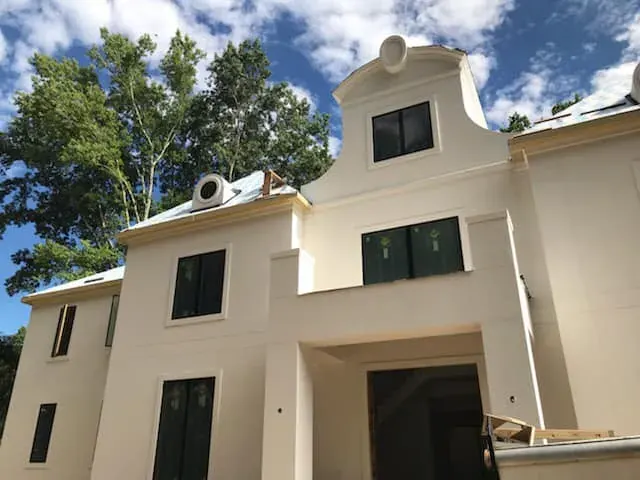
Where flashing belongs in a stucco wall
These are the locations we check on every flashing inspection, homes and commercial alike.
Window head
A drip-edged flashing over each window and door that carries water out past the frame.
Sill pan
A pan under the window with end dams and a back leg, draining water that gets past the frame.
Roof-to-wall & step
Pieces woven with each shingle course where a sloped roof runs along a stucco wall.
Kick-out
The angled piece at the bottom of a roof-to-wall run that throws water clear of the wall.
Parapet cap
Metal coping or cap flashing on wall tops, with sealed joints and a slope toward the roof.
Through-wall & ledger
Flashing at floor lines, deck ledgers and transitions to other materials that drains the wall.
Often paired with this work
Most wall problems involve more than one part of the envelope.
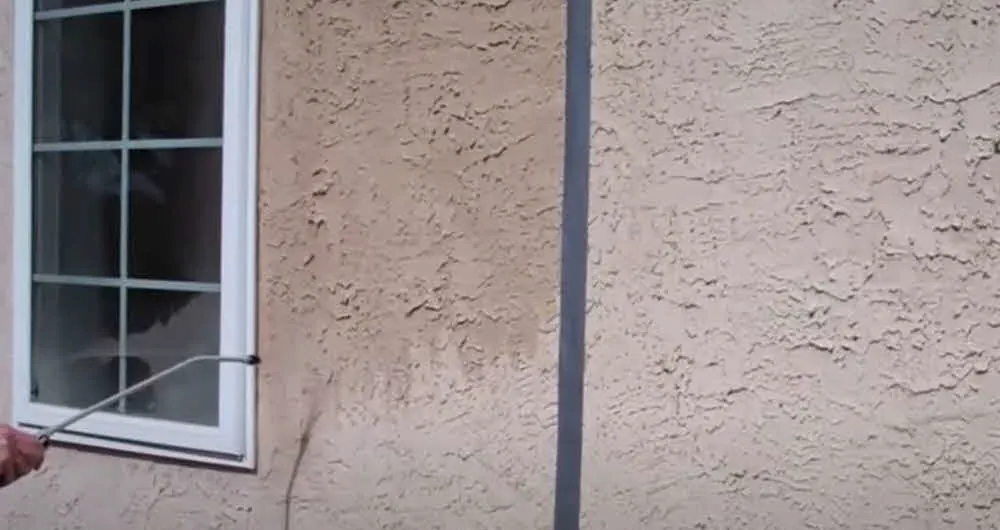
Stucco Waterproofing
Stucco is not a waterproof skin on its own.
Learn more
Stucco Waterproofing Coatings
A coating is a long-term decision for a building: it changes how the wall handles rain, vapor and movement for years.
Learn moreWaterproof Coating Systems
Your house may have stucco on the upper walls, a parged block foundation below and a brick or concrete porch in between.
Learn more
Commercial Waterproof Coatings
On a commercial building the coating is rarely the hard part.
Learn more
Stucco & EIFS Protection Coatings
Hard coat stucco and EIFS look alike from the street, but they are built very differently and tolerate different products.
Learn more
Protect Existing Systems
A facade that is ten or twenty years old is usually not failing everywhere.
Learn moreHow flashing failures show up
Flashing problems leave patterns. Water from a window head tends to stain the wall at the top corners; a failed sill pan shows up below the bottom corners or inside on the floor. A missing kick-out leaves a streak or rot at the foot of the roof line.
Matching the stain pattern to the likely detail lets us open the smallest area needed to fix it properly.
| Flashing | Common fault | Typical sign |
|---|---|---|
| Window head | Behind barrier or missing | Stains at upper corners |
| Sill pan | No pan or no end dams | Damage below the sill |
| Roof-to-wall | Short or unlapped steps | Wet wall along roof line |
| Kick-out | Missing or flattened | Streak at roof edge |
| Parapet cap | Open joints, flat slope | Leaks below wall top |
How we correct stucco flashing
Flashing repairs are part metalwork, part stucco work; both have to be right.
Confirm the detail
We use moisture readings and close inspection to confirm which flashing has failed and how far the water has spread from it.
- Readings around the detail
- Pattern of damage traced
- Repair area marked
Open & reflash
Stucco is cut back, wet sheathing is replaced, and new flashing is installed and lapped correctly with the weather barrier.
- Wet substrate replaced
- Flashing lapped correctly
- Lath and barrier tied in
Rebuild & match
Base and finish coats are rebuilt around the new flashing, sealant joints are installed where needed, and texture and color are matched.
- Coats cured properly
- Joints sealed
- Finish blended
Stains at window corners?
That pattern usually points to flashing. A quick check tells you for sure.
What our customers say
Homeowners and long-time commercial clients on working with ASR.
“I got quality of work with a quality product; the workmanship of his staff do amazing work. As a woman, I despise mess, I had none with the crew and the phenomenal way they cleaned up.”
“For over 10 years we have relied on ASR for all our stucco repair needs, but as well, for a number of other water intrusion related solutions. Their leadership are responsive and have trained their technicians well.”

“A quality honest contractor is hard to come by – I’d use ASR for anything I could.”
Stucco flashing questions
What owners ask when flashing is the suspected cause.
Can flashing be fixed without removing stucco?
Why do windows in stucco walls leak so often?
Can sealant replace flashing?
Do you flash parapets on commercial buildings?
How do I get flashing checked?
Get your flashing checked
We will find the detail that is letting water in and rebuild it so the wall stays dry.
Request a consultation & estimate
Homeowners and commercial clients alike: tell us about the property and what you are seeing.
- Call(888) 592-1304
- E-mailinfo@advstucco.com
- Headquarters138 Mountain Brook Dr, Canton, GA 30115
- HoursMon–Fri 8:30 am – 5:30 pm
Send us your project details
Residential or commercial. We’ll get back to you to set up an evaluation.
We never share your information. Prefer to talk? Call (888) 592-1304.