
- Home
- Stucco Waterproofing That Stops the Leak Path
Stucco Waterproofing That Stops the Leak Path
Stucco is not a waterproof skin on its own. It sheds most rain, absorbs some and relies on flashing, sealant joints and a drainage layer to deal with the rest. We find which of those has failed on your wall and correct it.
- Flashing & kick-outs
- Sealant joints renewed
- Coatings that breathe
- Homes & commercial

Request a consultation & estimate
Residential or commercial. We’ll get back to you to set up an evaluation.
We never share your information. Prefer to talk? Call (888) 592-1304.
A wall is only as dry as its weakest detail
Most water that ends up behind stucco does not soak through the field of the wall. It enters at the edges: a window perimeter with a split sealant bead, a roof line with no kick-out, a deck ledger that was never flashed, a hose bib or light box cut through the finish. Gravity and wind-driven rain then carry it down the sheathing, out of sight.
That is why waterproofing a stucco wall is a set of details, not a single product. Flashing has to turn water outward. Sealant joints have to stay bonded on both sides. The weather barrier behind the lath has to be lapped shingle-style, and the weep screed at the base has to let water out. A coating helps once those are right; it cannot make up for them.
We start every waterproofing job by locating the entry points with moisture readings, then fix them in order of risk. On a house that may be two windows and a roof corner. On a commercial building it may be a parapet cap and every storefront joint on one elevation. If you suspect a leak but cannot see one, begin with leak detection; for roof-to-wall corners see kick-out flashing.
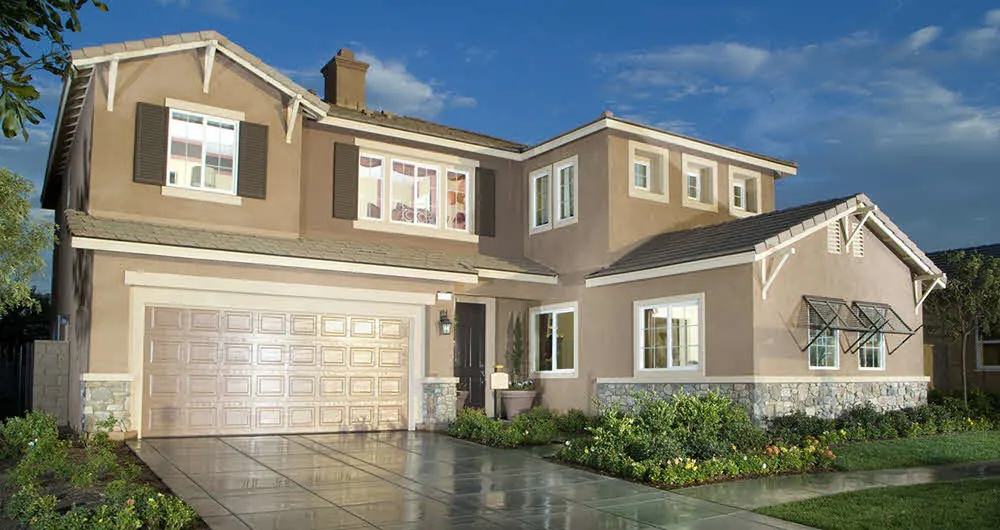
What keeps a stucco wall dry
When one of these layers is missing or worn out, the others get overloaded. We check all four on every wall we waterproof.
Flashing
Head flashings, sill pans, kick-outs and parapet caps that send water back out to the face of the wall.
Sealant joints
Perimeter joints at windows, doors and penetrations, sized and backed so the sealant can stretch without tearing.
Weather barrier & drainage
The membrane behind the lath and the weep screed at the bottom, which together drain any water that gets past the stucco.
Surface coatings
Elastomeric or breathable finishes that cut water absorption and bridge fine cracks on a sound wall.
Leak path diagnosis
Probe readings and targeted water testing that show which detail is leaking before money goes into a fix.
Commercial envelopes
Parapets, storefront systems, expansion joints and rooftop equipment curbs on offices, retail and hotels.
Often paired with this work
Most wall problems involve more than one part of the envelope.

Stucco Waterproofing Coatings
A coating is a long-term decision for a building: it changes how the wall handles rain, vapor and movement for years.
Learn more
Waterproof Coating Systems
Your house may have stucco on the upper walls, a parged block foundation below and a brick or concrete porch in between.
Learn more
Commercial Waterproof Coatings
On a commercial building the coating is rarely the hard part.
Learn more
Stucco & EIFS Protection Coatings
Hard coat stucco and EIFS look alike from the street, but they are built very differently and tolerate different products.
Learn more
Protect Existing Systems
A facade that is ten or twenty years old is usually not failing everywhere.
Learn moreLeak Detection
Water behind stucco can travel several feet before it shows up as a stain, and sometimes it never shows at all.
Learn moreWhich waterproofing work your wall needs
The symptom points to the remedy. A stain under one window corner usually means a perimeter joint or a missing sill pan. Streaking below a roof line points to a kick-out. Dampness spread across a whole elevation, with no single source, can mean the finish has become porous and a coating is worth discussing.
We put the findings in writing with photos, recommend the work in order of priority and let you approve each item. Small detail repairs can be done on their own; a full-elevation coating is only recommended once the details are fixed.
| What you see | Likely cause | Typical remedy |
|---|---|---|
| Stain at a window corner | Failed joint or no sill pan | Reflash and reseal |
| Streaks below a roof edge | Missing kick-out | Retrofit kick-out, repair wall |
| Damp base of wall | Buried or blocked weep | Regrade, clear or replace screed |
| Dark, absorbent finish | Worn or porous coating | Repairs, then recoat |
| Leak at a parapet | Open cap or coping joint | New cap flashing and sealant |
How we waterproof a stucco wall
The order matters: diagnose, correct the details, then protect the surface.
Locate entry points
We take moisture readings at windows, doors, roof lines and penetrations and, where needed, water-test a suspect detail to confirm it.
- Readings mapped by elevation
- Suspect details tested
- Written findings with photos
Correct the details
Missing flashing is added, failed joints are cut out and resealed, and any wet sheathing found along the way is replaced before the stucco is rebuilt.
- Flashing added or rebuilt
- Joints backed and resealed
- Wet substrate replaced
Protect & inspect
Where a coating makes sense, we prepare and apply it over the repaired wall, then walk the job with you and note what to watch in future.
- Coating where it fits
- Final walkthrough
- Upkeep notes for you
Not sure where the water is coming from?
That is the first thing we answer, before recommending any product.
What our customers say
Homeowners and long-time commercial clients on working with ASR.
“Outstanding results and very professional in every aspect during the construction and painting work done. Excellent follow-up by the President to ensure satisfaction during and after the job was completed.”
“We had numerous issues with the stucco on our newly constructed home… The stucco has a unique texture and is pigmented so we were really concerned about getting a good aesthetic match on the repairs… The stucco finish looks incredible and perfectly matches the house in color and texture.”

“We had the inside and outside (Hardie Siding) of our home painted by Advanced Stucco. Additionally, they made some necessary repairs and improvements outside. Very thorough job!! We’re extremely happy with their work, professionalism and punctuality.”
Stucco waterproofing questions
Answers for homeowners and building owners trying to keep water out.
Is stucco waterproof?
Will a waterproof coating stop my leak?
What is the most common leak source on stucco homes?
Do you waterproof commercial stucco and EIFS?
How do I start?
Find out where water is getting in
Tell us what you are seeing. We will trace the leak path and give you a prioritized, written plan.
Request a consultation & estimate
Homeowners and commercial clients alike: tell us about the property and what you are seeing.
- Call(888) 592-1304
- E-mailinfo@advstucco.com
- Headquarters138 Mountain Brook Dr, Canton, GA 30115
- HoursMon–Fri 8:30 am – 5:30 pm
Send us your project details
Residential or commercial. We’ll get back to you to set up an evaluation.
We never share your information. Prefer to talk? Call (888) 592-1304.