- Home
- Commercial
- Expansion Joints That Prevent Cracking
Expansion Joints That Prevent Cracking
Large stucco and EIFS walls move with temperature, moisture and the structure behind them. Expansion and control joints give that movement a planned place to go. We install them in new work, repair failed ones and add them where long cracks show a joint was missing.
- Control joints in stucco
- Expansion joints in EIFS
- Floor-line & structural joints
- Cracks from missing joints

Request a consultation & estimate
Residential or commercial. We’ll get back to you to set up an evaluation.
We never share your information. Prefer to talk? Call (888) 592-1304.
Movement goes somewhere
Every building material changes size. Portland cement stucco shrinks as it cures and keeps expanding and contracting with heat and moisture. Wood framing shrinks at floor lines, steel frames deflect, and different wall materials meet at transitions. If a wall has nowhere to relieve that movement, it cracks, and the crack becomes the joint.
A control joint breaks a hard coat stucco wall into panels so shrinkage cracks happen at a straight accessory instead of across the field. An expansion joint goes further, separating the cladding completely at floor lines, building sections or changes in substrate so structural movement does not tear the wall. In EIFS, expansion joints are formed through the system and sealed with backer rod and sealant.
On multi-story hotels, offices and multifamily buildings, where joints go is set by the design and the system manufacturer’s specification. We follow those, point out conflicts early to the GC and repair joints that have failed. For the sealant inside the joint, see exterior joint sealants.

Typical joint locations
The drawings and the manufacturer’s specification decide the final layout. These are the places we expect to see a joint on a commercial wall.
Floor lines
Wood-framed buildings shrink at each floor, so a horizontal expansion joint lets the cladding above and below move independently.
Building sections
Where the structure has its own expansion joint, the stucco or EIFS must have a matching joint directly over it.
Large wall panels
Hard coat stucco is divided into panels with control joints so shrinkage cracks land in the joint, not in the field.
Openings
Windows, storefronts and doors concentrate stress at their corners, so joints are often aligned with the opening edges.
Substrate changes
Where framing meets masonry or concrete, the two move differently, and a joint separates the cladding over each.
Abutments
Cladding meeting columns, roofs, canopies and other materials needs a sealed movement joint, not a hard butt.
Often paired with this work
Most wall problems involve more than one part of the envelope.
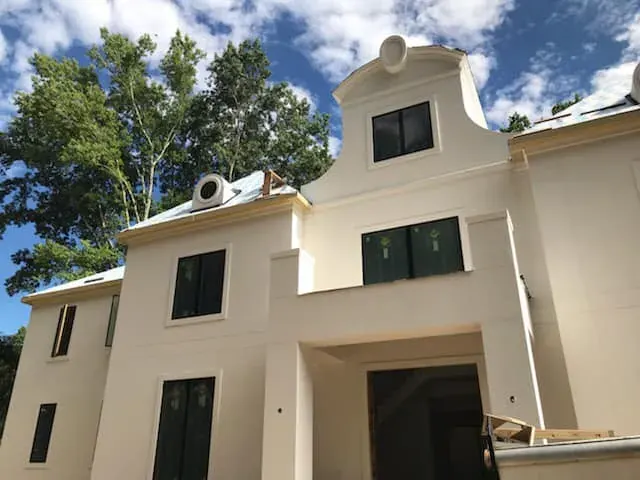
Sealants
On a stucco or EIFS house, the narrow bead of sealant around each window, door and pipe does more to stop rain than the wall itself.
Learn more
Exterior Joint Sealants
A commercial facade has hundreds of linear feet of perimeter and control joints, and each one is designed to stretch and compress.
Learn more
Sealant Replacement
Aged sealant on a commercial building fails quietly, one joint at a time, until tenants report water.
Learn more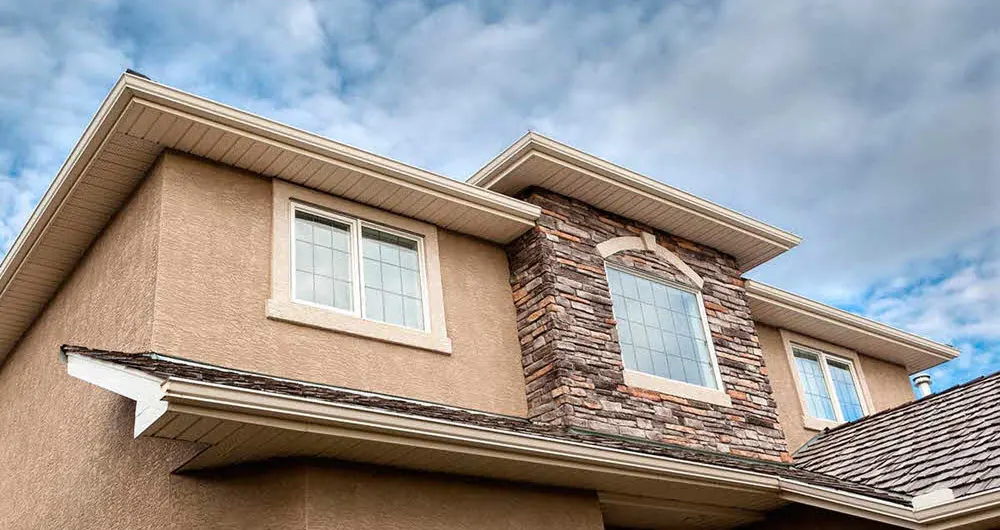
Stucco Repair
A crack or a stain is usually the visible end of a water problem.
Learn more
EIFS Repair
A dent in EIFS is more than cosmetic once the mesh is broken, and a dark streak below a window often means wet foam.
Learn more
Leak Detection
Water behind stucco can travel several feet before it shows up as a stain, and sometimes it never shows at all.
Learn moreTwo joints, two jobs
Owners and managers often hear both terms used loosely. The difference matters when a wall is cracking: a crack along a floor line calls for a true expansion joint, while a field crack in a large stucco panel may mean control joints were spaced too far apart or skipped.
Fixing cracks from a missing joint is not just patching. We cut a new joint along the line where the wall wants to move, install the right accessory or form an EIFS joint, seal it and blend the stucco or finish on each side. Then the crack has a place to go besides back through the repair.
| Feature | Control joint | Expansion joint |
|---|---|---|
| Purpose | Controls shrinkage cracks | Absorbs structural movement |
| Cuts through | Stucco and lath | Entire cladding system |
| Typical place | Within large panels | Floor lines, building sections |
| Finish | Accessory with sealant | Backer rod and sealant |
| Missing shows as | Field cracks | Long horizontal or vertical cracks |
How we repair and add expansion joints
Joint work on a finished building is done elevation by elevation, with lifts or scaffolding set to keep entrances and parking open where possible.
Read the cracks
We map crack patterns against floor lines, openings and structure to tell whether a joint failed, was mislocated or was never installed.
- Crack map by elevation
- Structure compared
- Moisture checked at cracks
Cut & form
Failed joints are opened and cleaned. Where a joint is missing, we cut a straight line through the cladding, protect the substrate and install the accessory or form the EIFS joint.
- Straight cut lines
- Substrate protected
- Edges back-wrapped on EIFS
Seal & blend
Backer rod and sealant are installed to the joint design, and the stucco or finish on both sides is repaired and color matched so the joint reads as intended.
- Joint sealed
- Finish matched
- Elevation inspected
Long cracks along a floor line?
That pattern usually points to a joint problem. Have it evaluated before patching it again.
What our customers say
Homeowners and long-time commercial clients on working with ASR.
“Great attention to detail and workmanship. Really appreciate the effort to carefully caulk all stucco penetrations and amazingly good job of matching the stucco color since I had the stucco painted 5 years before.”
“We had a section of our wall that was crumbling, and I was worried the repairs would stand out. Not only did they fix the issue, but they matched the color and texture so perfectly that I honestly can’t tell where the damage was.”

“Excellent customer service and craftsmanship! I have used Darrin and the team several times and have never been disappointed!”
Expansion joint questions
Questions property managers, owners and contractors ask about joints in stucco and EIFS.
What is the difference between a control joint and an expansion joint?
Why is my stucco cracking in a straight line at each floor?
Can expansion joints be added to an existing building?
How often do expansion joints need maintenance?
Who decides where the joints go on new construction?
Have your wall joints evaluated
Send the form or call (888) 592-1304. We will look at the cracking and the joints on your building and explain the repair in a written scope.
Request a consultation & estimate
Property managers, owners, HOAs and general contractors: tell us about the building and what you are seeing.
- Call(888) 592-1304
- E-mailinfo@advstucco.com
- Headquarters138 Mountain Brook Dr, Canton, GA 30115
- HoursMon–Fri 8:30 am – 5:30 pm
Send us your project details
Residential or commercial. We’ll get back to you to set up an evaluation.
We never share your information. Prefer to talk? Call (888) 592-1304.