
- Home
- Commercial
- Exterior Joint Sealants Built to Move
Exterior Joint Sealants Built to Move
A commercial facade has hundreds of linear feet of perimeter and control joints, and each one is designed to stretch and compress. We install sealant joints on stucco and EIFS buildings the way the joint design and manufacturer’s specification call for, so they stay bonded through Georgia heat and cold.
- Perimeter & control joints
- Backer rod & primer
- Stucco & EIFS substrates
- Occupied buildings phased

Request a consultation & estimate
Residential or commercial. We’ll get back to you to set up an evaluation.
We never share your information. Prefer to talk? Call (888) 592-1304.
A joint is a system, not a bead
On a hotel, office or retail building, exterior joint sealant is engineered work. The joint has a width set by how much the adjacent materials will move, a depth controlled by backer rod, and a sealant chosen for that movement and that substrate. Leave out any piece and the joint fails early, usually by tearing at one edge.
The key idea is two-sided adhesion. Sealant should stick to the two faces of the joint and nothing else. Backer rod or bond-breaker tape keeps it off the back, so the bead can stretch like an hourglass instead of ripping. On EIFS, the sealant bonds to the base coat, not the finish, which is a detail many crews skip and a common cause of failed perimeters.
We install sealants at window and storefront perimeters, panel and control joints, penetrations and dissimilar-material transitions on stucco and EIFS buildings. For existing joints that have already failed, see sealant replacement; for movement joints themselves, see expansion joints.

The parts of a lasting sealant joint
Each component is cheap compared with the cost of a leak. Skipping one is where most joint failures start.
Joint width & depth
Width is sized to the expected movement, and depth is held to the sealant maker’s ratio so the bead can flex.
Backer rod
Closed-cell or open-cell rod sized slightly larger than the joint sets depth, shapes the bead and prevents three-sided bonding.
Primer
Where the manufacturer calls for it, primer on stucco, EIFS base coat or metal improves bond in a joint that will be working for years.
Compatible sealant
We select sealant rated for the movement and approved for contact with the EIFS or stucco system and the adjacent frame.
EIFS base coat bond
On EIFS, the joint faces are left at base coat so the sealant grabs a sound layer instead of a textured finish.
Documentation
Joint locations, products and photos are recorded in Jobber so owners and GCs have a record for future maintenance.
Often paired with this work
Most wall problems involve more than one part of the envelope.

Sealants
On a stucco or EIFS house, the narrow bead of sealant around each window, door and pipe does more to stop rain than the wall itself.
Learn more
Sealant Replacement
Aged sealant on a commercial building fails quietly, one joint at a time, until tenants report water.
Learn more
Expansion Joints
Large stucco and EIFS walls move with temperature, moisture and the structure behind them.
Learn more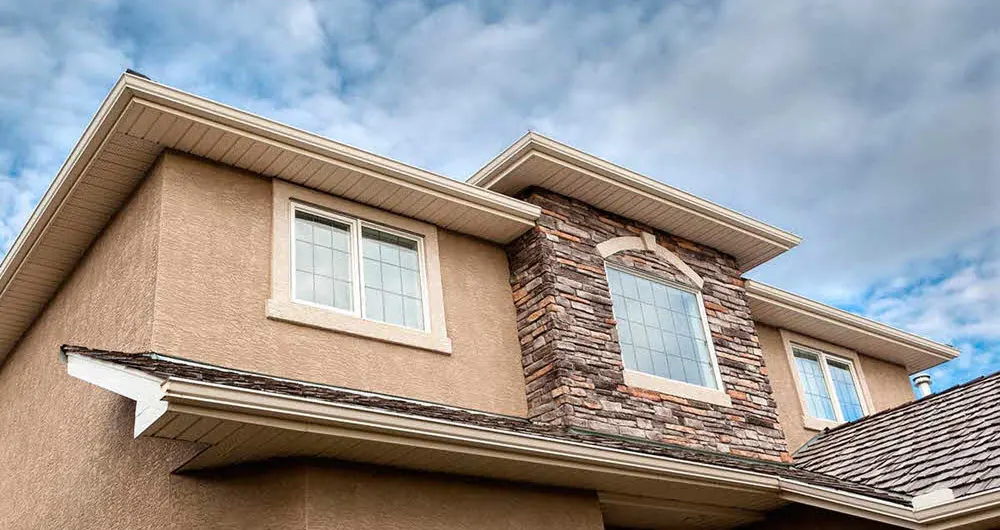
Stucco Repair
A crack or a stain is usually the visible end of a water problem.
Learn more
EIFS Repair
A dent in EIFS is more than cosmetic once the mesh is broken, and a dark streak below a window often means wet foam.
Learn more
Leak Detection
Water behind stucco can travel several feet before it shows up as a stain, and sometimes it never shows at all.
Learn moreDifferent joints, different demands
Not every joint on a building works the same way. A storefront perimeter sees thermal movement from a long metal frame. A control joint in hard coat stucco opens and closes as panels shrink and expand. A transition to masonry or a roof edge joins two materials that never move together.
We look at each joint type on your drawings or on site and match the sealant, backer and prep to what that joint has to do. On new work we coordinate with the general contractor so joints are formed at the right width before sealant day.
| Joint | Main stress | Key detail |
|---|---|---|
| Window & storefront perimeter | Frame expansion | Base coat bond on EIFS |
| Control joint | Panel shrinkage | Bond breaker at back |
| Expansion joint | Structural movement | Width sized to movement |
| Dissimilar materials | Uneven movement | Primer per substrate |
| Penetrations | Water at fasteners | Full perimeter seal |
How we install exterior joint sealants
Sealant work is weather sensitive, so we schedule around rain, surface temperature and dew, and phase elevations on occupied buildings.
Review & survey
We review the specification or survey the building, confirm joint widths and substrates, and agree on sealant products and colors with the owner or GC.
- Joint types listed
- Products confirmed
- Colors approved
Prepare joints
Joint faces are cleaned to sound material, dried, masked and primed where required. Backer rod or bond breaker is set to the correct depth.
- Faces cleaned & dry
- Primer where specified
- Backer depth set
Install & inspect
Sealant is gunned full, tooled tight to both faces and checked as each elevation is finished, with photos logged for the project record.
- Tooled concave
- Adhesion spot checks
- Photo record in Jobber
Bidding a sealant scope?
Send the specification or a description of the building and we will review the joint details with you.
What our customers say
Homeowners and long-time commercial clients on working with ASR.
“Each and every person has a positive attitude that is projected with every task, duty and responsibility. The team did a terrific job on safety, maintenance and housekeeping, in addition to applying their craft(s).”
“Great attention to detail and workmanship. Really appreciate the effort to carefully caulk all stucco penetrations and amazingly good job of matching the stucco color since I had the stucco painted 5 years before.”
“We had a section of our wall that was crumbling, and I was worried the repairs would stand out. Not only did they fix the issue, but they matched the color and texture so perfectly that I honestly can’t tell where the damage was.”

Exterior joint sealant questions
Questions property managers, owners and general contractors ask about facade sealants.
What is two-sided adhesion and why does it matter?
Why should sealant on EIFS go against the base coat?
Which sealant do you use on stucco and EIFS?
Can you work while our building is open?
Do you work for general contractors on new construction?
Get your facade joints done right
Share your building or specification and call (888) 592-1304 or send the form. We will review the joints and send a written scope through Jobber.
Request a consultation & estimate
Property managers, owners, HOAs and general contractors: tell us about the building and what you are seeing.
- Call(888) 592-1304
- E-mailinfo@advstucco.com
- Headquarters138 Mountain Brook Dr, Canton, GA 30115
- HoursMon–Fri 8:30 am – 5:30 pm
Send us your project details
Residential or commercial. We’ll get back to you to set up an evaluation.
We never share your information. Prefer to talk? Call (888) 592-1304.