
- Home
- Residential
- Sealants That Keep Water Out of Your Walls
Sealants That Keep Water Out of Your Walls
On a stucco or EIFS house, the narrow bead of sealant around each window, door and pipe does more to stop rain than the wall itself. We inspect it, cut out what has failed and install sealant that is matched to your wall and built to move with it.
- Windows & doors
- Pipes, vents & fixtures
- Trim & siding transitions
- Renewal before leaks start

Request a consultation & estimate
Residential or commercial. We’ll get back to you to set up an evaluation.
We never share your information. Prefer to talk? Call (888) 592-1304.
Small bead, big job
Stucco sheds most of the rain that hits it, but every place the wall stops and something else starts is a weak spot: the edge of a window frame, a door threshold, a hose bib, a dryer vent, a light fixture, the line where stucco meets wood trim or a chimney. At each of those spots, a sealant joint is what keeps wind-driven rain from slipping behind the finish.
Sealant does not last as long as the house. Georgia sun bakes it, summer heat and winter cold stretch and squeeze it, and after enough seasons it hardens, cracks or pulls away from one side. Once there is a gap, water runs down the inside of the wall where you cannot see it, soaking sheathing until stains or soft spots show up indoors or on the stucco.
We treat sealant as maintenance a homeowner can plan for, not an afterthought. If a joint has already leaked, we check the wall behind it with leak detection first. For the commercial side of this work, see exterior joint sealants.
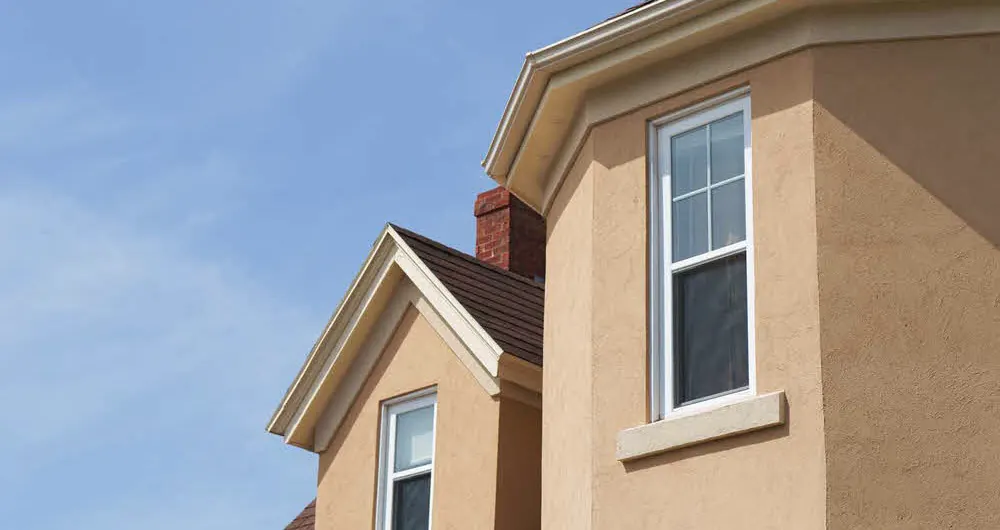
The joints we check on every house
Walk around your home with us and these are the places we look at first.
Window perimeters
The joint between the frame and the stucco is the most common leak point on a stucco home, especially at the lower corners.
Door frames & thresholds
Entry and patio doors take splashback and foot traffic, so their side and sill joints wear out faster than most.
Pipes, vents & wiring
Hose bibs, dryer and bath vents, AC lines and cable entries are often sealed once at build time and never again.
Fixtures & mounts
Light fixtures, outlets, house numbers and satellite mounts need a sealed top edge so water does not run into the screw holes.
Material transitions
Stucco meeting wood trim, fiber cement, stone veneer or a chimney moves differently on each side, and the joint takes up that movement.
Sun-facing elevations
South and west walls bake all afternoon, and their sealant usually cracks and shrinks before the shaded sides do.
Often paired with this work
Most wall problems involve more than one part of the envelope.

Exterior Joint Sealants
A commercial facade has hundreds of linear feet of perimeter and control joints, and each one is designed to stretch and compress.
Learn more
Sealant Replacement
Aged sealant on a commercial building fails quietly, one joint at a time, until tenants report water.
Learn more
Expansion Joints
Large stucco and EIFS walls move with temperature, moisture and the structure behind them.
Learn more
Stucco Repair
A crack or a stain is usually the visible end of a water problem.
Learn more
EIFS Repair
A dent in EIFS is more than cosmetic once the mesh is broken, and a dark streak below a window often means wet foam.
Learn more
Leak Detection
Water behind stucco can travel several feet before it shows up as a stain, and sometimes it never shows at all.
Learn moreWhen to inspect, when to reseal
There is no single date stamped on a sealant joint. How long it holds depends on the product, how well it was installed and how much sun and water that side of the house gets. The practical approach is to look every year and replace joints as they start to fail, before the gaps open.
A yearly walk-around in spring is easy to do yourself: look for cracking, joints pulling away from the stucco and dark streaks below windows. When several joints show wear, a whole-house reseal costs less trouble than chasing one leak at a time.
| What you see | What it means | Next step |
|---|---|---|
| Soft, flexible bead | Joint is working | Recheck next year |
| Surface cracking | Sealant is aging | Plan a reseal |
| Gap at one edge | Bond has failed | Replace soon |
| Stains below joint | Water may be inside | Moisture test first |
| Caulk over caulk | Old layers trapped | Cut out and redo |
How we reseal a stucco home
Most homes are resealed in a day or two, depending on how many openings there are and how much old material has to come out.
Walk & note
We go around the whole house, mark every joint that has cracked or let go, and check the wall below any suspect window with a moisture probe.
- Every opening checked
- Wet spots flagged
- Photos in Jobber
Cut out & prep
Old sealant is removed down to clean surfaces, not smeared over. Edges are cleaned and dried, and backer rod goes in where the joint is deep.
- Old caulk removed
- Surfaces cleaned
- Joint depth set
Seal & tool
We apply a sealant suited to stucco and the neighboring material, tool it so it bonds to both sides, and pick a color that suits the wall and trim.
- Compatible sealant
- Tooled for adhesion
- Color chosen with you
Caulk cracked or missing?
A reseal now is a much smaller job than a wall repair after the next few storms.
What our customers say
Homeowners and long-time commercial clients on working with ASR.
“For over 10 years we have relied on ASR for all our stucco repair needs, but as well, for a number of other water intrusion related solutions. Their leadership are responsive and have trained their technicians well.”

“A quality honest contractor is hard to come by – I’d use ASR for anything I could.”
“Outstanding results and very professional in every aspect during the construction and painting work done. Excellent follow-up by the President to ensure satisfaction during and after the job was completed.”
Home sealant questions
What homeowners ask us about caulk and sealant on stucco houses.
How often should sealant on a stucco house be replaced?
Can I just caulk over the old sealant?
Is any caulk from the hardware store fine for stucco?
Should the bottom of a window be sealed?
What if I already see stains under a window?
Book a whole-house sealant check
Send the form or call (888) 592-1304. We will look at every joint on your home and tell you which ones need work now and which can wait.
Request a consultation & estimate
Tell us about your home and what you are seeing, and we will set up an evaluation.
- Call(888) 592-1304
- E-mailinfo@advstucco.com
- Headquarters138 Mountain Brook Dr, Canton, GA 30115
- HoursMon–Fri 8:30 am – 5:30 pm
Send us your project details
Residential or commercial. We’ll get back to you to set up an evaluation.
We never share your information. Prefer to talk? Call (888) 592-1304.